




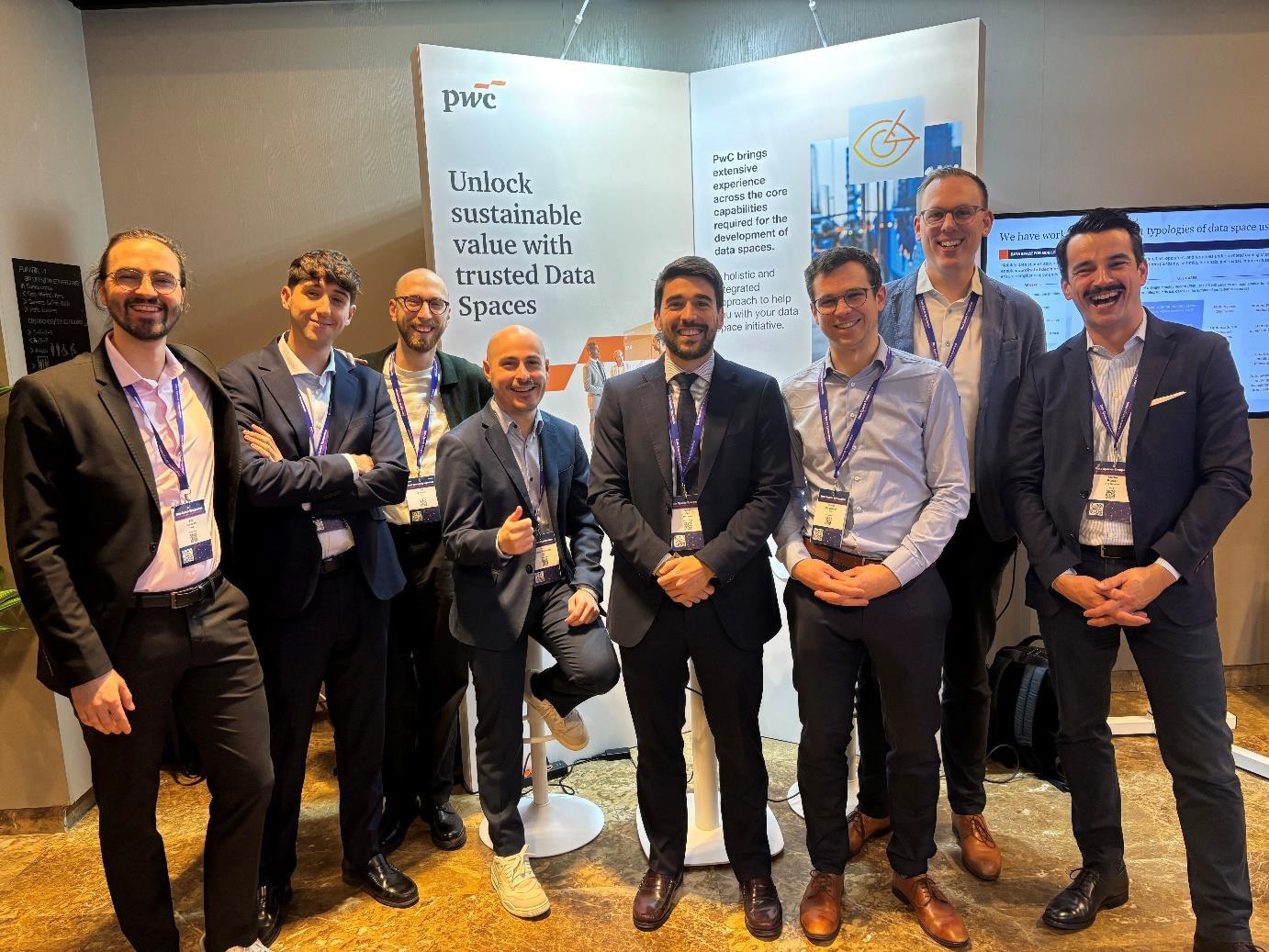
Stakeholder perspectives: from vision to first implementations
In Madrid, PwC engaged in intensive discussions with a wide range of stakeholders from various sectors and public institutions.
Drawing from these diverse perspectives, we made the following observations:
The strategic relevance of data spaces for competitiveness, resilience and innovation is widely recognized
However, the journey is still at a relatively early stage
Fragmented technical solutions for specific aspects of data spaces are already out there
Certain productive data spaces exist – but we are still far from broad, harmonized solutions and adoption at scale.
In other words: the vision is clear, the first concrete steps are visible, but the landscape is still heterogeneous and evolving.
This leads to a set of pressing questions that many stakeholders raised:
how do we move from concepts and isolated initiatives to more coherent ecosystems?
Which use cases offer clear, demonstrable value for specific industries?
How do we ensure that not only large organizations, but also small and medium-sized enterprises (SMEs) can participate and benefit?
These questions are now at the centre of the debate and will largely determine the pace of progress over the next few years.
As technical foundations emerge, ecosystem maturity must catch up
One of the recurring themes at the symposium was the state of technical maturity of data spaces. From PwC’s perspective, the situation can be summarized as follows:
- There is a solid but still fragmented base of reference architectures, standards and technical building blocks.
- Some components and frameworks are being used in pilots and early implementations, but there is no consistency and interoperability across initiatives yet.
Therefore, in the coming years the focus will be less on inventing new technologies and more on aligning existing approaches, filling gaps, and ensuring the overall setup is operational and scalable for a broad set of participants.
To achieve this, the next step is to increase the maturity of the ecosystem by developing a common understanding of roles, responsibilities and incentives; establishing trustworthy and practical governance models; designing business models that clarify how value is created and shared among participants; and building capabilities to onboard and support a large number of participants across territories and sectors.
In other words: the technology is catching up, but scaling the ecosystem – particularly in terms of business value and organizational adoption – is the defining task of the next phase.
The central role of use cases – why SMEs are critical
A clear takeaway from our discussions in Madrid is that relevant, well-defined use cases are the key to driving adoption. Stakeholders agreed on several points:
- Data spaces will only gain traction if they address concrete, high-priority challenges, not just abstract ambitions
- The most promising use cases depend on the specific sector and regulatory context, but they must all create clear, measurable value – for example through efficiency, transparency, innovation, or compliance
- Without a convincing value proposition, initiatives risk remaining in the pilot phase.
Equally important is the role of SMEs: SMEs form the backbone of many economies and are critical actors in supply chains and local ecosystems. If SMEs cannot participate easily, data spaces will not reflect real-world value networks and will miss a significant portion of their potential. For SMEs, both the benefits and the path to participation must be clear: a tangible value proposition (e.g. access to new data, services or markets; process efficiencies; reduced risk); low technical barriers through simple integration options and ready-to-use services; manageable economic barriers through appropriate pricing and support models; and reduced organisational complexity thanks to guidance on governance, legal and operational questions.
Lowering these barriers is essential to achieve broad participation and to move from isolated initiatives to vivid, sustainable ecosystems.

“Who Onboards the Millions?” – Local service providers as key enablers
One of the highlights of the Data Spaces Symposium was the “Who onboards the millions? Solving data spaces at scale” session organized by the Data Spaces Adoption Forum. It addressed a central question: how do we move from a limited number of early adopters to widespread adoption across thousands or even millions of organisations?
PwC shares the view that local service providers will play a central role in this scaling: they are close to SMEs and other local actors and understand their specific needs, constraints and priorities. They can act as trusted intermediaries, helping organisations interpret requirements, select suitable technical solutions and comply with governance rules. They can support the creation of a decentralised yet interoperable ecosystem, where adoption is driven locally but aligned with common standards and frameworks.
From PwC’s perspective, this calls for a multi-level approach:
At global level, the focus is on standards, reference models and best practices
At regional and national level, the focus is on adapting these frameworks to regulatory environments, funding schemes and ecosystem initiatives
At local level, the focus is on practical onboarding, training and support for SMEs and other participants.
PwC’s global Centre of Excellence, combined with strong local teams in each territory, is designed to support this multi-level challenge.
PwC’s perspective: from trend to transformation
Reflecting on the discussions in Madrid, we see several clear trends shaping the next phase of data space development — focused on defining and implementing sustainable business and pricing models.

In this evolving landscape, PwC is a bridge builder:
- We can connect technology and business by translating technical possibilities into viable and compliant business models.
- We can connect global frameworks and local realities by adapting approaches to concrete regulatory, cultural and market conditions.
- We can connect policy initiatives and corporate strategies by helping organisations align with regulatory requirements while unlocking business value.

Looking ahead
The Data Spaces Symposium 2026 in Madrid has clearly shown that data spaces are moving from vision to first implementations. The foundations are there, though still fragmented; the next task is to scale with focus, coordination and clear value.
For PwC, this means:
Further strengthening our global collaboration within the PwC Data Space Centre of Excellence
Working closely with clients and partners to identify and implement high-impact, sector-relevant use cases
Supporting SMEs and local ecosystems with concrete services that lower the barriers to entry and make participation not just feasible but rewarding.
We see data spaces as a cornerstone of future digital value creation. Our commitment is to help design and implement these ecosystems in a way that is scalable, trustworthy and economically meaningful for organisations of all sizes, across all sectors and territories.
PwC will continue to actively engage in the data spaces community and to share insights from our projects and collaborations. The journey from early pilots to widely adopted data ecosystems has begun – and we are committed to shaping it alongside our clients, partners and the broader ecosystem.
For further information, please contact:
Managing Partner Advisory, Technology Consulting & Innovation, Brussels, PwC Belgium
+32 495 59 08 40
Florian Barthélemy
Martin Röser
Partner, CIO Advisory, Frankfurt am Main, PwC Germany
Pascal Kohlhase
Manager, CIO Advisory, PwC Germany
Andrés Diego
Ander Cid


