






CBAM : Going from a reporting and financial obligation to a competitive advantage
PwC's Carbon Border Manager: CBAM reporting made easy
Video
CBAM Reporting Tool
1:33
More tools
Transcript
Introducing our brand-new SAP CBAM Module, the Carbon Border Manager, part of the Award-winning SAP Check Your Value Chain solution.
Designed for EU importers, this powerful ERP agnostic tool lets you make impact assessments and forecasts by comparing the outcome of using default values versus actual verified emission data, showing you which products and suppliers have the most impact in your total CBAM cost. Furthermore, it automates your CBAM reporting—saving you time, effort, and costs by using real emissions data and your suppliers’ installation info.
Ready to simplify compliance and gain clear insights?
Request your demo now and experience the future of CBAM reporting!
Navigating the EU CBAM in global trade supply chains
As Europe continues its drive towards becoming the world’s first climate-neutral continent by 2050, the Carbon Border Adjustment Mechanism (CBAM) represents a pivotal shift in how carbon emissions are managed across global supply chains.
Part of the broader European Green Deal, CBAM is designed to ensure that goods imported into the EU are subject to the same carbon pricing as those produced within its borders. From January 2026, importers of CBAM-regulated goods are required to be authorised declarants and purchase CBAM certificates (starting February 2027), marking the start of financial obligations under the mechanism.
The introduction of CBAM is a direct response to the risk of carbon leakage, where companies could evade the EU's emissions rules by relocating production to countries with lower environmental standards or by importing cheaper, carbon-intensive goods. By imposing a carbon cost on these imports equivalent to the EU's own Emissions Trading System (ETS), CBAM aims to level the competitive playing field. This not only protects the integrity of Europe’s climate policies but also encourages global partners to accelerate their own decarbonisation efforts.
Products in Scope
CBAM initially targets imports of carbon-intensive goods in the customs territory of the EU, focusing on 6 sectors: cement, electricity, fertilizers, aluminium, iron and steel, and hydrogen.
Some examples of the products in scope
- Cement
- Iron and steel
- Hydrogen
- Aluminium
- Fertilisers
- Electricity
Cement
- bagged cement
- tile adhesives
- grouts
- industrial products like ready-mix concrete
- dry mixes of cement-based mortar
- precast concrete barriers
- road slabs
- curbs
- bulk cement
- concrete masonry units (CMUs) such as hollow and solid concrete blocks, as well as concrete brick
Iron and steel
- Crude steel (ingots, billets, slabs)
- Hot-rolled and cold-rolled steel (plates, sheets, strips)
- Steel bars and rods (e.g., rebar, for bird cages, for decoration material, for furniture)
- Stainless steel and carbon steel products (kitchenware products)
- Steel wire and wire products (e.g., mesh, nails, cables)
- Steel tubes and pipes (seamless, welded)
- Galvanized steel (coils, sheets)
- Pig iron and direct reduced iron (DRI)
- Iron ore
- Steel castings
Hydrogen
- Liquid hydrogen used in sectors such as in rocketry, aerospace, and potentially in long-range transportation (e.g., shipping and aviation).
- Hydrogen used in fuel cells, especially in sectors like automotive (hydrogen fuel cell electric vehicles, FCEVs), stationary power generation, and backup power
- Grey hydrogen
- Blue hydrogen
- Green hydrogen (via electrolysis, depending on certification)
- Liquid hydrogen
- Hydrogen for industrial uses (e.g., ammonia, methanol, steelmaking)
Aluminium
- Primary aluminum (ingots, slabs, billets)
- Aluminum sheets, plates, and foils (for toys, vehicles, interior decor)
- Extruded aluminum profiles (rods, tubes, bars)
- Aluminum alloys (billets, slabs)
- Aluminum automotive parts (wheels, body panels)
- Cast aluminum products (engine parts, machinery components)
- Aluminum wire and cable (for power transmission)
- Aluminum packaging (cans for drinks, foils for packet crisps or chocolates, trays for f&b products)
- Aluminum building materials (cladding, frames, doors)
Fertilisers
- Nitrogen-based fertilizers (Urea, Ammonium Nitrate, Ammonium Sulfate, Calcium Ammonium Nitrate)
- Compound fertilizers (NPK, DAP, MAP)
- Industrial feedstocks like ammonia and nitric acid
- Calcium nitrate and potassium nitrate fertilizers, especially where nitrogen is a component
Electricity
- Imported grid electricity (from non-EU countries via interconnectors)
Between 2026 to 2034, CBAM aims to include additional goods produced in sectors covered by the EU ETS, to create a level playing field.
This expansion will gradually cover both direct and indirect emissions, ensuring a more comprehensive approach to preventing carbon leakage and strengthening global climate action.
The Commission has already put forward a proposal to expand the scope to downstream iron, steel, and aluminium goods starting in 2028 further impacting EU importers
With a clear focus on carbon-intensive goods, further scope extension proposals are expected in the coming months, including for chemical and plastic goods.
CBAM Implementation Timeline

Start of the definitive phase
(Starting 1 January 2026)
During the definitive phase, EU importers or their indirect customs representatives, who import more than the single mass-based threshold of 50 tonnes of CBAM goods annually into the EU, will have to apply for authorised CBAM declarant status to continue importing CBAM goods. After application, the national competent authority will provide importer or indirect customs representative with a CBAM account number. This marks the start of the financial obligations under CBAM, where importers must ensure they have sufficient certificates to cover the emissions of their goods.
- Become an authorised CBAM declarant
Ensure registration as an authorised declarant to continue importing CBAM goods. EU customs authorities won’t allow entry of CBAM goods into the EU customs territory by parties other than authorised CBAM declarants. - Annual CBAM declaration
Submit a yearly CBAM declaration by 30 September of each year (starting in 2027 for 2026 imports), detailing the total carbon emissions embedded in CBAM imports and the number of CBAM certificates surrendered.
- Purchase CBAM certificates
Starting from February 2027, purchase CBAM certificates corresponding to the emissions embedded in imported CBAM goods and comply with the minimum quarterly purchasing requirements. - Surrender CBAM certificates
Surrender the required number of CBAM certificates annually to cover the emissions associated with CBAM imports. This is before 30 September 2027 for 2026 imports.
Timeline for the first CBAM declaration based on 2026 imports.


What CBAM means for your business
CBAM is a gamechanger for any business importing CBAM goods into the EU. It puts a direct price on the carbon embedded in imports, turning emissions data into a commercial and customs reality.
This isn't just a compliance issue. CBAM is a cross-functional challenge with implications spanning tax, customs, supply chain, sourcing, sustainability, legal, finance, and IT. From accurate customs declarations and CBAM certificate management to supplier emissions data, contractual clauses, and procurement strategy, every function has a role to play.
The businesses that win will be those that break down silos, embed carbon into sourcing decisions, and treat CBAM as a strategic priority. Carbon pricing at the border is here to stay and the time to act is now.

Key Actions to Take Now
CBAM compliance is no longer a future concern: it's an immediate operational priority. Here are the key actions your business should take today to stay compliant, control costs, and build a competitive edge:
- 1. Establish strong CBAM governance
- 2. Secure your authorised CBAM declarant status
- 3. Get your customs classification and master data right
- 4. Calculate your CBAM liability while preparing for your CBAM declaration
- 5. Engage your suppliers on emissions data
- 6. Implement robust reporting systems
- 7. Refine and future-proof your supply chain
- 8. Prepare for CBAM certificate management
- 9. Anticipate the 2028 scope expansion
1. Establish strong CBAM governance
CBAM is a cross-functional topic touching various teams within an organisation. Appoint clear leadership and a dedicated governance structure to coordinate across functions, ensure accountability, and turn compliance into cost-saving opportunities.
2. Secure your authorised CBAM declarant status
If you import more than 50 tonnes of CBAM goods annually, you must be registered as an authorised CBAM declarant. Without this status, you won’t be able to import CBAM goods into the EU from January 2026 onward.
3. Get your customs classification and master data right
Accurate Harmonised System (HS) / Combined Nomenclature (CN) code classification and clean master data are the foundation of CBAM compliance. Review your tariff classifications, validate your import flows, and ensure you can reliably identify and track CBAM-covered goods across your operations.
4. Calculate your CBAM liability while preparing for your CBAM declaration
Your CBAM liability and your CBAM declaration go hand in hand as both rely on the same underlying customs and emissions data. Model your 2026 CBAM cost now based on current import flows, embedded emissions, and projected certificate prices, then collect customs and emissions data continuously throughout 2026 to keep your estimate up to date. This continuous approach not only prepares your company for the upcoming CBAM declaration, but also helps you anticipate cash-flow impacts, budget accurately for certificate purchases, and identify cost-mitigation levers before they're locked in.
5. Engage your suppliers on emissions data
Build effective communication channels with your suppliers to obtain verified embedded emissions data for the goods you import. Early engagement is critical. Suppliers who cannot provide reliable data will become a compliance and commercial risk.
6. Implement robust reporting systems
(Applicable to non-EU installations) Put in place the processes, tools, and controls needed to report embedded emissions in the required format. Ensure foreign installations are registered in the EU CBAM registry and that you are ready to meet annual reporting obligations for both direct and indirect emissions (depending on the goods imported).
7. Refine and future-proof your supply chain
Identify weaknesses and carbon hotspots in your supply chain. Form strategic partnerships, diversify sourcing where needed, and align your procurement strategy with your carbon reduction goals to minimise CBAM costs over time.
8. Prepare for CBAM certificate management
From 2026, importers will need to purchase, hold, and surrender CBAM certificates to cover their embedded emissions. Build the financial planning, treasury, and operational processes needed to manage certificate purchases—and potential resales—efficiently.
9. Anticipate the 2028 scope expansion
The CBAM scope is expected to broaden significantly from 2028, potentially covering downstream products and additional sectors. Start scenario-planning now to understand how an expanded scope could affect your product portfolio and sourcing strategy.
Ensure compliance and secure cost savings
How We Can Help
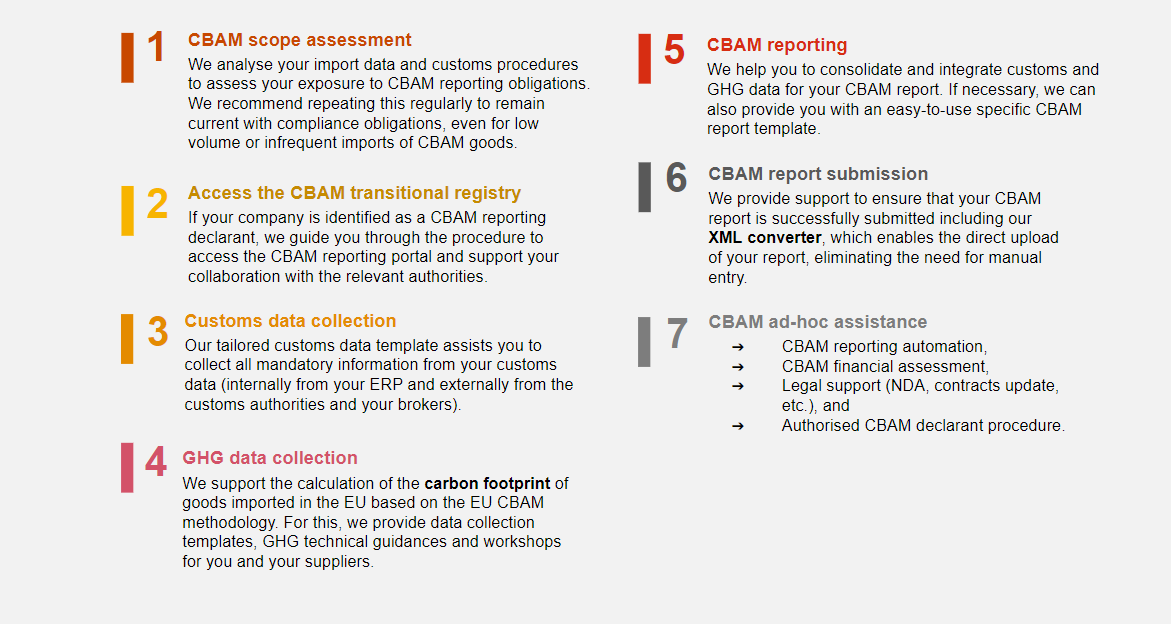
Our dedicated CBAM experts are here to assist your company in navigating the complexities of CBAM. Our multidisciplinary team covers every function that CBAM touches.
Our scope of assistance includes:
As of 1 January 2026, CBAM turns emissions into an import liability
Download for more information
Contact our CBAM specialists
Lorenzo Costa
Aurélien Denis
Lorenzo Costa
Interested?



Connect with PwC Belgium


Contact us



External Senior Counsel Tax ERP transformation, PwC Belgium
Tel: +32 496 51 30 80