




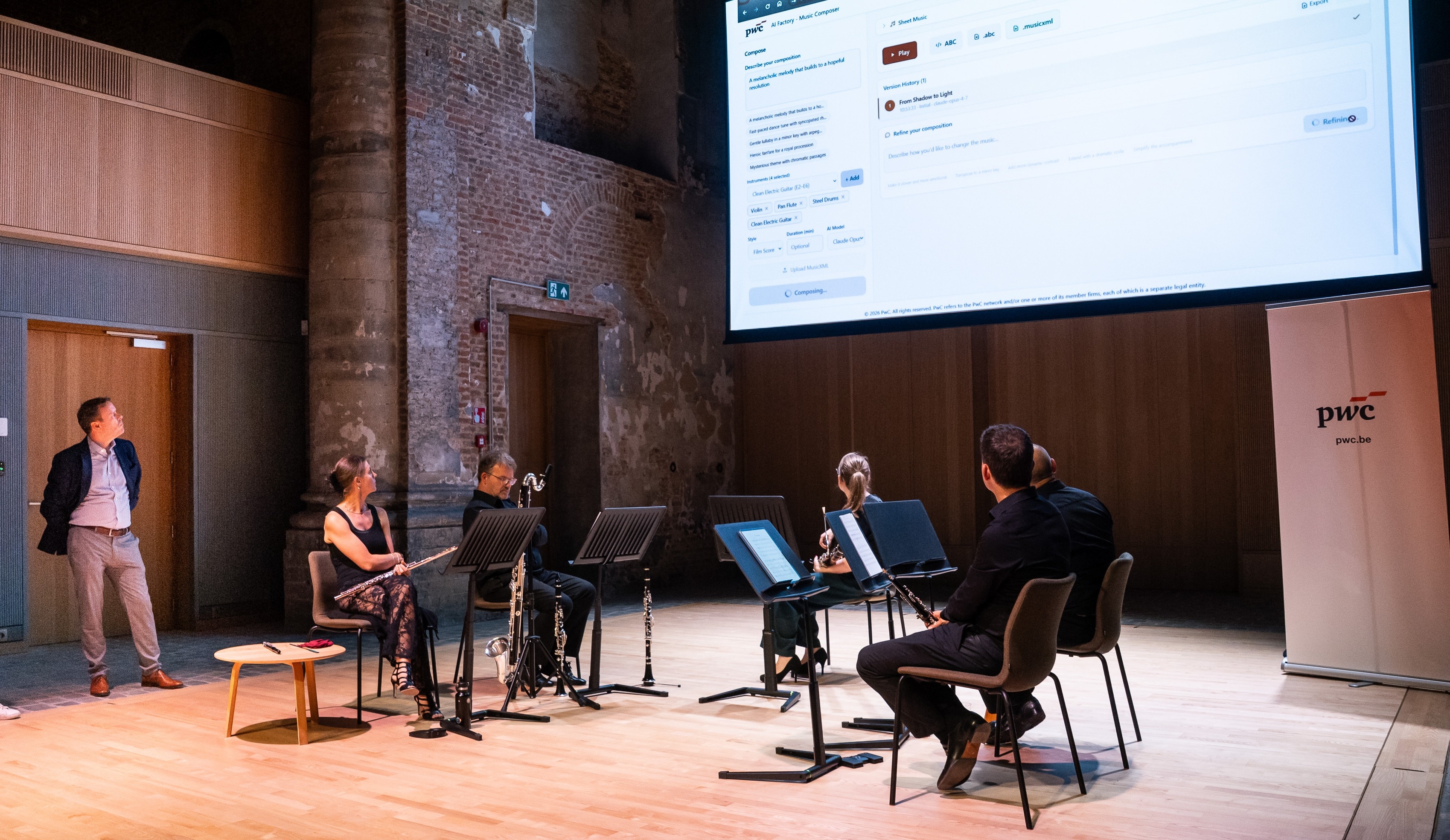
A pioneering project has been born out of a discussion between old friends—the generation of a piece of classical music based on an AI prompt. The musical composition is the result of a collaboration between PwC Belgium and Casco Phil, a Belgian chamber orchestra that presents surprising concert projects at home and abroad. The piece was showcased on 29 May 2026 at a concert entitled Late Nigh Avant-Garde—Black Box and was played by a woodwind quintet. The ambition of the project was to investigate and gauge the positive and negative of AI when it comes to musical composition. As well as the need to be creative with AI to conceive more meaningful solutions—a concept applicable beyond the realms of music.
Taking a broader view of AI
Explains Arne Herman, general manger and dramaturg with Casco Phil, “AI’s a technology that has the potential to be extremely disruptive in the world of music. We’re not the first musicians to be experimenting with AI or to create a piece of music using AI. There are many examples of people showing just how much AI can do. And it can do a lot. With this project, we wanted to broaden the perspective and talk about the impact of AI. And by doing so look at the potential disruptive impact of AI on a broader scale.”
Agrees Casco Phil’s artistic director Benjamin Haemhouts, “In the classical music business, there’s a big concern that composers will be sidelined by AI music, something we already see happening. We’re working with the model created by PwC to show that there’s an irreplaceable element in creating original music and that’s human beings. There’s a big difference between models that create pop music and the model we’re using. It’s a very different algorithm.”

Confirming AI’s lack of creativity
AI models used to create pop music use existing music in templates and adapt them to deliver new songs. Casco Phil, with PwC’s help, decided to start from scratch to test how creative a machine really is. The result, according to Benjamin Haemhouts, is that, “it’s not creative at all. The creativity of real, new music can’t be made only by AI. You can have a basic idea, but the magic only happens when a human refines it.”
The model was a standard generalist Large Language Model (LLM) model which is good at software coding, making it also good at ABC notation—a shorthand form of musical notation for computers—that could then be linked with full music.
“Like Casco Phil, PwC’s extremely open and looking to be one step ahead. That’s something that connects us strongly.”
Benjamin Haemhouts, artistic director, Casco PhilCreativity isn’t just for music
It’s the creativity side of the project that was of particular interest to PwC. “You find creativity in many realms, not just music. It’s really about storytelling be that in engineering, bookkeeping, or wherever. Creativity’s a broad palette which is why we’re so interested in exploring it in this way,” explains Arthur De Vleeschauwer, a Manager with PwC’s Advisory practice and a driving force behind our AI Factory. He goes on, “If you’ve got original ideas, you’ve nothing to fear with AI. That’s as true in business as it is in the world of music.” While the parallels between what the project is looking to achieve and PwC’s business may not be immediately apparent, there are many learning points that are applicable. It particularly highlights PwC’s creativity in terms of applying AI.

The power of experimentation
Explains Michiel De Keyzer, Director Cloud, Data and AI at PwC, “it’s really about the power of experimentation. Finding out what the limitations are when you apply AI to a context it hasn’t been designed for, namely a generalist LLM. Finding out how to contextualise a problem in a way that it can be used by an LLM was interesting and something we can reuse. It was also educational to discover the lessons learned by Casco Phil in its experimentation, which can be applied to different contexts and are also relevant for our business. It really gave us ideas about where AI can be leveraged, how we can get it to work in different contexts, and what it can mean for creative work if you take it to the extreme.”
The supportive role of AI
An important parallel is the use of AI as an assistant. Recalls Arne Herman, “before notation software, people wrote on paper. That they now use software doesn’t change their creative genius. It simply improves the process of creating music and makes it faster and more efficient. Great artists will remain great artists. And I see that being true in any industry.” He sees AI as “a good assistant that you can rely on to do grunt work.” Arthur De Vleeschauwer concurs, “When we speak with clients, we explain that part of the benefit of AI is that it frees time for people to focus more on the creative or original parts of their work and less on the iterative work that supports that. If you use is as an assistant, you can do more and better things.”
© Björn Comhaire
All photographs appearing in the content of this webpage are property of Björn Comhaire and are protected under international copyright laws.
Contact us

Managing Partner Advisory, Technology Consulting & Innovation, PwC Belgium
Tel: +32 495 59 08 40