




What does this mean for individuals from a personal income tax perspective?
Circular 2026/C/74 | Published 22 July 2026
On 22 July 2026, the Belgian tax authorities published Circular 2026/C/74 providing detailed guidance on the new capital gains tax on financial assets, introduced by the Law of 6 April 2026. The tax applies within the personal income tax framework (not corporate tax or non-resident tax) and is effective from 1 January 2026. It targets gains realised outside any professional activity, within normal management of private assets, and only upon transfers for valuable consideration. Historical gains accrued before 2026 are protected through a “reference date” mechanism (value on 31.12.2025).
Three regimes at a glance
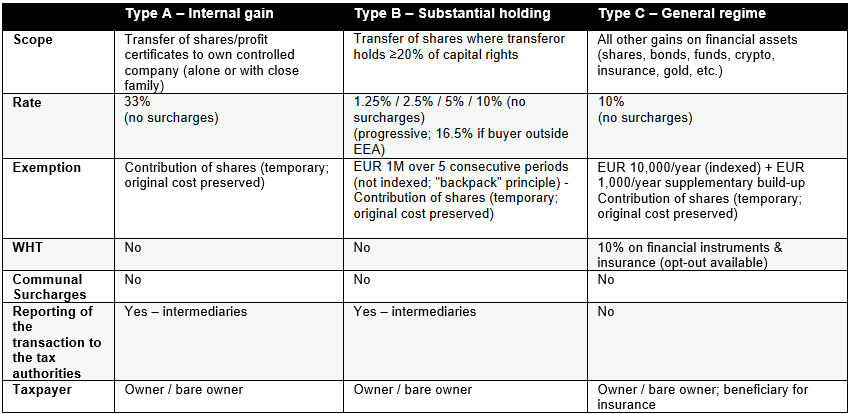
Priority: Type A prevails over B; Type B prevails over C. A transaction can only fall under one regime.
Type A – Internal capital gains: impact on entrepreneurs
Internal sales of shares to a holding company controlled by the transferor (alone or with close family under art. 1:14 BCCA) are now automatically taxed at 33%. This targets the former practice of selling shares to one’s own holding, but its scope is broader as it hits transfer of shares other than those of the holding, financing the price via tax-free dividend upstreaming. The contribution of shares remains exempt (as future capital reductions will be taxed as dividends), but the original acquisition cost is preserved for any later disposal. The control test is assessed at the moment of transfer; joint control with a PE fund typically does not trigger Type A; family successions to children’s holdings fall outside this regime.
Type B – Substantial shareholding: key features
Taxpayers holding at least 20% of capital rights — assessed individually at the moment of transfer — benefit from progressive rates (1.25% to 10%) and a EUR 1 million exemption available once in 5 consecutive taxable periods. Only shares count (not profit certificates/options/warrants), and only directly held participations. For married couples with community property, 40% is required (2×20%). A special 16.5% flat rate applies when shares in a Belgian company are transferred to a legal entity outside the EEA.
Type C – General regime: the “everyday investor” tax
This residual category covers all financial assets: listed/unlisted shares, bonds, ETFs, fund units, partnership interests, derivatives, insurance contracts (branch 21/23/26/44), crypto-assets (incl. NFTs used for payment/investment), investment gold, and digital central bank currencies. Excluded: payment instruments, cash on payment accounts, credit life/funeral insurance. The basic annual exemption of EUR 10,000 (indexed) shields small investors, with a supplementary EUR 1,000/year build-up in years without full utilization. A 10% WHT may be applied; taxpayers can opt out and settle via PIT return.
A Selection of Key Topics Covered in the Circular Letter
Determining the taxable base
Gain = proceeds minus acquisition cost (no deduction of transaction costs). For pre-2026 assets, acquisition cost = value on 31.12.2025 (last closing price for listed; highest of arm’s length / formula / equity+4xEBITDA for non-listed; or independent auditor/chartered accountant valuation by 31.12.2027). For insurance: inventory reserve on 31.12.2025 + post-2025 premiums. Transitional rule (until 31.12.2030): elect actual higher cost (cannot create a loss; weighted average applies). FIFO method for identical assets (per account). Capital losses deductible only within same period / taxpayer / category — no carry-forward.
Exit tax on emigration
Loss of Belgian tax residency = deemed realization of all financial assets. Automatic payment deferral for emigration to EU/EEA/treaty states (with
info exchange + mutual recovery assistance) (no formalities). Deferral lapses within 24 months if assets are sold, collateral arrangements are made, or taxpayer moves to non-qualifying state. Payment obligation definitively lapses upon return to Belgium within 24 months or after 24 months.. Annual certificate required.
Anti-abuse and interaction with existing rules
Art. 344, §1 ITC remains fully applicable. The circular targets: gratuitous transfers to non-residents with subsequent sale; current account structures via holdings; post-sale control changes; rapid re-sales outside EEA. Speculation/abnormal management (art. 90, 1° ITC) continues at 33% + surcharges — the administration bears the burden of proof. Interaction with Reynders tax (art. 19bis): 19bis amount is deducted from CGT base to avoid double taxation.
Recommended actions
- Document the value of all financial assets as at 31.12.2025 — this is the single most critical step.
- Engage an independent auditor/chartered accountant for non-listed financial assets valuations (deadline: 31.12.2027).
- Review shareholding structures: does the 20% threshold apply? Can the EUR 1M exemption be utilized?
- Assess control structures for Type A exposure — particularly family holding configurations.
- Gather evidence of actual acquisition costs exceeding the reference date value (transitional rule until 31.12.2030).
- Evaluate emigration plans in light of the exit tax and 24-month safe harbour.
- Consider WHT opt-out and optimise realisation timing for supplementary exemption build-up.
For more information, please contact Bart Van den Bussche, Luc Legon or your usual PwC advisor.
This publication has been prepared for general guidance on matters of interest only and does not constitute professional advice. You should not act upon the information contained herein without obtaining specific professional advice. © 2026 PwC. All rights reserved.
Authors

Newsletter
Value means different things to different people. That’s why you can decide to receive updates only for the issues that matter most to you.


